Vorixpay
Non-custodial stablecoin payments: merchants accept USDT and USDC, and the contracts make it impossible to send their money anywhere else.
01
Overview
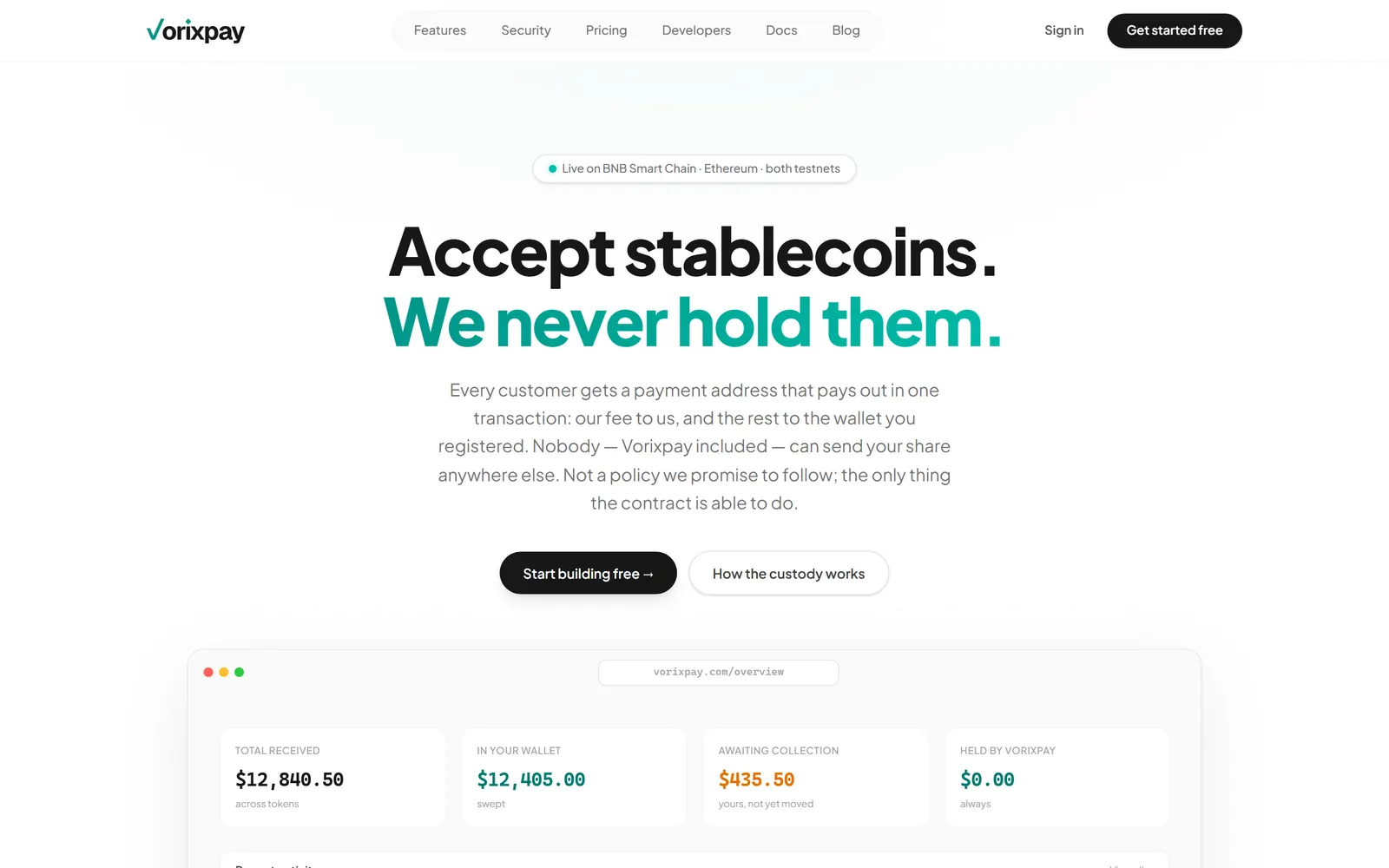
Vorixpay lets businesses accept stablecoin payments in USDT and USDC, through invoices or a permanent address for each of their customers. Every payment address is a small contract that, when collected, pays exactly two places in one transaction: Vorixpay's fee, and everything else to the wallet the merchant registered.
Built with Solidity smart contracts · BNB Smart Chain & Ethereum · REST API & signed webhooks · Next.js
02
The problem
Most crypto payment processors take the money, hold it, and send it on when the merchant asks. That gap is where withdrawal queues and frozen balances come from, and merchants are asked to trust a promise that their funds are safe. The goal was a processor that is structurally unable to hold or redirect a merchant's money.
03
Architecture
Three small on-chain contracts decide where money is allowed to go; an off-chain service finds payments, collects them and reports to merchants. Only one key is kept online, and it cannot change where anyone gets paid.
L1
Registry
- Payout wallet per merchant
- Fee rate and minimums
- Signed wallet changes
L2
Payment addresses
- One per invoice or customer
- Deployed on first collection
- Derived from the merchant key
L3
Detection
- Block-by-block reading
- Partial, over and late payments
- Checks every five minutes
L4
Collection
- Gas paid by Vorixpay
- Fee and payout in one transaction
- Small balances within 24h
L5
Developers
- REST API
- Signed, numbered webhooks
- Retries for about 16 hours
04
Challenges
Custody that is impossible, not just promised
The problem
"Non-custodial" usually means a policy the operator promises to follow.
The solution
Each payment address is a clone of one contract with no destination parameter, no owner, no arbitrary calls and no upgrade path. When collected it can only pay the fee and the merchant's registered wallet.
Nobody, Vorixpay included, can send a merchant's share anywhere else.
A stolen key can't redirect payouts
The problem
Wallet keys and server keys both leak in the real world.
The solution
Changing a payout wallet needs a signature from the current wallet and the merchant's Vorixpay account, sends an email and a webhook, then waits 24 hours so it can be cancelled. The one key kept online can pay gas and submit signed changes, but fees, the treasury and registered wallets are controlled from a wallet held offline.
A leaked wallet key or server key alone cannot move money a merchant is already set up to receive.
Never missing a payment
The problem
Polling individual addresses misses payments that arrive while nobody is watching them.
The solution
The service reads the chain block by block. Partial, over and late payments each get their own outcome, and balances are checked against the chain every five minutes.
Payments are found whether or not anyone is looking, and money that arrives late still reaches the merchant.
Free addresses at any scale
The problem
Deploying a contract for every customer up front costs gas for addresses that may never be used.
The solution
Addresses are derived in advance from the merchant's key, and the contract is only deployed the first time money there is collected. Each customer gets one permanent address, and asking twice returns the same one.
Issuing addresses is free; the cost is paid only when money arrives.
05
Key decisions
Small, non-upgradeable contracts
chosen over Upgradeable proxies
An upgrade path is a way to change where money goes. Leaving it out is what keeps the guarantee true.
Say plainly it is not audited
chosen over Letting people assume it is
Merchants should decide how much money to route through it with the full picture, so the site states that no external audit has been done yet.
Refuse Tron addresses for now
chosen over Issuing them optimistically
Address derivation works on Tron, but collection does not yet. Refusing is safer than accepting money it cannot sweep.
06
Impact
$0
Merchant money it can hold
24h
Delay on any payout-wallet change
2
Mainnets live
- Live and verified on BNB Smart Chain and Ethereum mainnet since September 2026
- Fees of 1% on BNB Smart Chain and 2% on Ethereum, settled in the same transaction
- Invoices and permanent customer addresses through one REST API
- A public page on exactly what merchants still trust it with
07
Gallery

Where a payment can go

Invoices found without anyone watching

One permanent address per customer

One API call per invoice
08
Lessons & what's next
“Saying what has not been done builds more trust than polishing what has.”
“The strongest security guarantee is a feature that does not exist.”
What's next
An external security audit, then Tron and subscriptions.